

Ever wondered why some baseball hitters can absolutely crush the ball without looking like they’re swinging out of their shoes? Meanwhile, other players put everything they’ve got into their swings but struggle to generate serious power.
The difference often comes down to something most hitters overlook: how efficiently their bodies work together.
That’s where improving exit velocity through advanced kinetic chain training becomes a game-changer. Instead of relying entirely on arm strength or swinging harder, this training approach focuses on creating and transferring power throughout the body.
Think of your baseball swing as a coordinated chain reaction. Your feet interact with the ground, your hips rotate, your torso follows, and your hands deliver the bat into the hitting zone.
When these movements happen efficiently, generating higher bat speed and harder contact becomes much more achievable.
In this guide, we’ll explore the biomechanics behind powerful hitting, explain how kinetic sequencing influences performance, and introduce practical training methods that can help you improve your exit velocity.
Whether you’re a competitive athlete or a hitting coach, understanding these concepts can take your baseball development to another level.
1. Understanding Exit Velocity and the Kinetic Chain
Before diving into advanced training techniques, it’s important to understand what exit velocity actually measures and why it’s so valuable.
Exit velocity is simply the speed at which a baseball leaves the bat after contact. It’s usually measured in miles per hour using tracking systems such as HitTrax, TrackMan, or other radar-based technologies.
Why Exit Velocity Matters in Baseball
According to MLB Statcast, a hard-hit ball is defined as a batted ball traveling at least 95 mph off the bat.
At the professional level, reaching this threshold is associated with substantially better offensive outcomes. Harder contact generally gives defenders less time to react and can increase the distance traveled by well-struck fly balls.
However, 95 mph isn’t a universal benchmark for every player. High school, youth, and amateur hitters should evaluate improvement relative to their age, competition level, and personal baseline.
The goal isn’t necessarily to match professional numbers immediately. It’s to consistently produce stronger contact than you could before.
How the Kinetic Chain Generates Power
The kinetic chain describes how different body segments coordinate to produce and transfer movement.
During a baseball swing, force production and rotation involve the lower body, pelvis, torso, shoulders, arms, and bat. These segments don’t work independently; each contributes to the overall movement.
Think about cracking a whip. The motion begins at one end, and coordinated movement allows the tip to accelerate rapidly.
Baseball hitting involves a more complicated process, but the general principle is similar.
When your hips, trunk, and upper body rotate with effective timing, the bat can accelerate without requiring excessive muscular effort from your arms.
Poor sequencing, on the other hand, can reduce efficiency and make a powerful swing harder to repeat.
2. Building Ground-Up Power Through Lower-Body Mechanics
If you’re serious about improving hitting power, start by looking at your feet.
Your lower body creates the foundation for rotational movement, balance, and efficient force transfer. Without adequate stability and strength, producing high bat speed becomes considerably more difficult.
Understanding Ground Reaction Forces
Whenever your feet push against the ground, the ground pushes back with an equal and opposite force.
These ground reaction forces help athletes accelerate, decelerate, and rotate during explosive movements.
A 2023 study published in Sports Biomechanics examined 20 collegiate baseball players and found that several ground reaction force measurements from the lead leg were significantly correlated with bat speed.
The researchers reported a correlation of approximately 0.66 between peak resultant lead-leg ground reaction force and bat speed.
While correlation doesn’t automatically prove causation, the finding emphasizes the importance of lower-body force production during hitting.
Training the Back Leg and Front Leg
The rear leg contributes to loading and positioning the hitter before rotation accelerates.
A controlled load allows the athlete to maintain balance while preparing to move into the swing. Excessive shifting or collapsing into the back hip can make timing more difficult.
The front leg plays a different role.
As the stride foot establishes contact, the lead side helps manage forward movement and supports rotational acceleration.
Many effective hitters demonstrate a firming front leg as the swing progresses, but this shouldn’t become an exaggerated locking movement.
Try practicing slow-motion swings while paying attention to your foot pressure and balance.
You should feel connected to the ground throughout the movement rather than jumping, lunging, or spinning uncontrollably.
Strengthening the Foundation
Squats, split squats, lateral lunges, and single-leg stability exercises can improve the physical qualities needed for an effective swing.
For example, split squats develop unilateral leg strength, while lateral lunges challenge your ability to control force in the frontal plane.
Start with controlled repetitions before progressing toward heavier or more explosive movements.
The objective isn’t simply building bigger legs. It’s developing strength that can be coordinated effectively during baseball-specific movement.
3. Mastering Hip Rotation and Torso Sequencing
One of the most fascinating parts of elite hitting mechanics is how the pelvis and upper body interact.
You might have heard coaches talk about opening the hips, keeping the shoulders closed, or creating separation. These ideas relate to rotational sequencing, but they’re often misunderstood.
What Is Hip-Shoulder Separation?
Hip-shoulder separation describes the rotational difference between the pelvis and torso during the swing.
As the pelvis begins turning toward the pitcher, the torso may remain relatively closed for a brief period.
This creates conditions in which the trunk muscles can contribute to subsequent rotational acceleration.
However, maximizing separation isn’t the goal for every hitter.
Excessive twisting can interfere with timing, balance, and mobility, particularly when athletes force positions their bodies aren’t prepared to handle.
Instead, aim for a smooth and consistant rotational sequence.
Why Timing Beats Maximum Rotation
Imagine two hitters with similar strength.
The first hitter rotates the hips and shoulders almost simultaneously, causing the upper body to rush forward. The second coordinates pelvic rotation with the movement of the torso and arms.
Depending on their individual mechanics, the second hitter may transfer rotational motion into the bat more effectively.
That’s why elite swing development focuses on movement quality rather than simply trying to rotate faster.
Your hips shouldn’t spin aimlessly, and your hands shouldn’t remain passive until the last possible moment.
Everything needs to operate within a coordinated timing window.
Training Rotational Control
A simple drill involves standing in your batting stance while holding a lightweight training stick across your shoulders.
Practice small, controlled pelvic rotations while keeping your torso stable enough to feel the difference between the two segments.
Next, allow your torso to follow naturally.
This isn’t meant to recreate the exact timing of a full-speed swing. It’s a movement-awareness exercise that helps you understand how the pelvis and upper body can move seperately.
Gradually transfer that awareness into controlled tee swings, then regular batting practice.
4. Developing Explosive Strength for Higher Bat Speed
Great mechanics create opportunities for power, but athletes also need the physical capacity to produce force quickly.
That’s where strength and conditioning become essential.
The best baseball training programs combine general strength, explosive movement, and sport-specific practice rather than relying exclusively on one exercise category.
What Research Says About Strength and Swing Velocity
A 2023 study published in Sports investigated 78 collegiate baseball players to identify physical characteristics associated with bat swing velocity.
Researchers found significant relationships between swing speed and several measurements, including grip strength, back muscle strength, and backward overhead medicine-ball throwing performance.
Interestingly, the study didn’t identify significant relationships between swing speed and the standing long jump or 30-meter sprint measurements.
These findings suggest that specific strength and explosive-power qualities may be particularly relevant to hitting performance.
However, the results were correlational. They don’t mean that improving one exercise automatically guarantees a faster swing.
Rotational Medicine-Ball Training
Medicine-ball throws are especially useful because they allow athletes to practice explosive movements involving the hips, torso, and upper body.
A 2021 study involving NCAA Division III baseball players found a moderate correlation between rotational medicine-ball throw velocity and batted baseball velocity.
The reported correlation was approximately 0.53, supporting the relevance of whole-body rotational power.
One practical exercise is the rotational scoop toss.
Stand sideways to a sturdy wall, hold a lightweight medicine ball near your rear hip, and rotate explosively while throwing the ball into the wall.
Focus on producing a fast, coordinated movement instead of simply using the heaviest ball available.
Start with three sets of four to six quality repetitions on each side, adjusting the workload to your training experience.
Combining Strength With Explosive Movement
Traditional strength exercises provide a foundation, while power-oriented exercises challenge your ability to apply force rapidly.
For example, an athlete might perform a set of squats followed by a few controlled medicine-ball throws.
This combination can encourage the development of strength and explosive movement capacity, although the best programming depends on training history and recovery.
Avoid turning every repetition into an exhausting workout.
High-quality power training requires sufficient rest, becuase explosive performance can deteriorate when fatigue becomes excessive.
5. Advanced Kinetic Chain Drills for Baseball Hitters
Once you understand the mechanics, the next step is applying them to actual training.
The most effective hitting drills target a specific movement problem and provide feedback that helps the athlete make meaningful adjustments.
Step-Back Rotation Drill
This exercise encourages controlled loading and coordinated lower-body movement.
Begin in your normal batting stance with a bat held comfortably. Move your rear foot slightly backward, establish balance, and then return toward your hitting position before swinging.
The movement should feel rhythmic rather than rushed.
Avoid excessive backward movement or letting your upper body drift away from the plate.
Perform five to eight controlled repetitions, then take regular swings to determine whether the improved rhythm carries over.
Medicine-Ball Separation Drill
Hold a lightweight medicine ball near your torso while standing in an athletic position.
Rotate your pelvis slightly while maintaining enough torso control to avoid turning the entire body simultaneously.
Then perform a smooth rotational throw toward a suitable wall or training partner.
This exercise can help reinforce rotational coordination, but remember that medicine-ball mechanics aren’t identical to baseball swing mechanics.
The goal is to develop useful movement qualities that support hitting.
Front-Leg Stability Drill
Set up in your normal stance and take a modest stride into a balanced landing position.
Pause briefly, maintain stable posture, and perform a controlled swing.
This drill helps hitters recognize whether their front leg provides sufficient support without requiring exaggerated stiffness.
After several repetitions, remove the pause and perform the movement continuously.
A coach can record the swing from the side to evaluate posture, balance, and rotational timing.
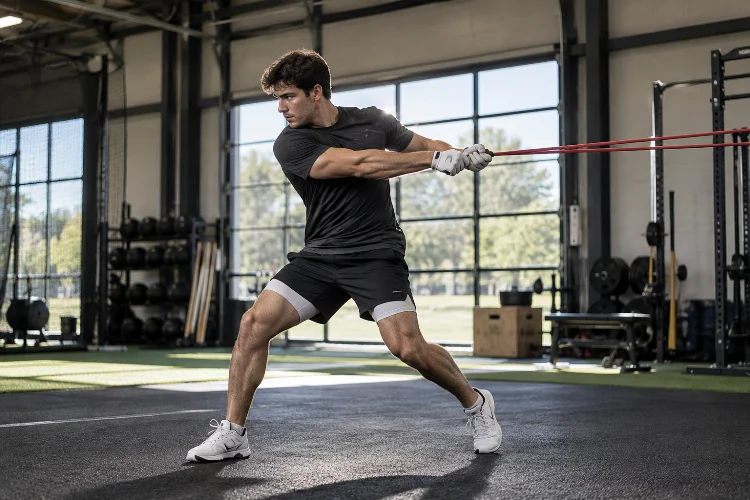
Resistance-Band Rotation Drill
Attach a resistance band securely at approximately chest height.
Stand in an athletic position and rotate your torso against the resistance while maintaining controlled hip and knee positioning.
Use moderate resistance that allows the movement to remain smooth.
The objective is to build rotational strength and control, not to imitate every detail of the baseball swing under heavy resistance.
For most athletes, two or three sets of six to ten repetitions per side provide a reasonable starting point.
Stop if the movement creates joint discomfort or noticeable compensations.
6. Turning Kinetic Chain Efficiency Into Harder Contact
Here’s something important: increasing bat speed doesn’t automatically guarantee better hitting performance.
You still need to meet the baseball with the barrel, control the direction of the swing, and make adjustments against different pitches.
Bat Speed and Exit Velocity Work Together
According to Driveline Baseball, bat speed is one of the primary factors influencing how hard a baseball can be hit.
Their training resources describe an approximate relationship in which an additional 1 mph of bat speed may support roughly 1.2 mph of additional exit velocity when relevant collision conditions remain similar.
That’s a useful illustration, not a guaranteed improvement for every hitter.
Pitch speed, bat properties, impact location, and contact efficiency also influence the outcome.
Imagine increasing your bat speed but regularly contacting the ball near the handle.
Your maximum potential might improve, yet your actual batted-ball results may remain disappointing.
Using Overload and Underload Training
Overload and underload bat training involves swinging implements that are heavier or lighter than a normal game bat.
Heavier implements can challenge specific strength and force-production qualities, while lighter implements allow athletes to practice faster movements.
Driveline Baseball uses both approaches within its bat speed development programs.
However, beginners shouldn’t immediately start swinging extremely heavy bats at maximum intensity.
Use purpose-built training equipment, follow an age-appropriate progression, and maintain enough control to avoid changing your swing into an awkward movement pattern.
A simple training session could involve a small number of lighter-bat swings, regular-bat swings, and supervised heavier-bat swings.
Afterward, return to your game bat and evaluate both speed and contact quality.
Improving Barrel Accuracy
One of the most valuable exercises is alternating between two hitting objectives.
During the first round, focus on generating strong bat speed. During the next, focus on striking the baseball near the sweet spot while maintaining good movement quality.
Then combine the two goals in normal batting practice.
Use a launch monitor when available to recieve immediate feedback on contact results.
You want to see your ability to hit the ball hard become more repeatable, not just produce one impressive maximum reading.
7. Creating a Four-Week Exit Velocity Training Plan
Training without a measurable goal can quickly become frustrating.
A structured plan gives hitters a way to connect mechanical improvements, strength development, and performance outcomes.
Week 1: Establish Your Baseline
Start by measuring your current exit velocity using consistent testing conditions.
Record approximately 15 to 20 well-organized swings from a tee or another repeatable setup.
Track average exit velocity, maximum exit velocity, and the average of your hardest few contacts.
If possible, also record bat speed and capture video from the side and rear angles.
Use these measurements to identify your primary limitation.
For example, a hitter with strong peak exit velocity but inconsistent average contact may benefit from barrel-control training more than additional maximum-effort work.
Week 2: Improve Movement Quality
Dedicate this week to foundational mechanics and rotational coordination.
Practice controlled loading, front-leg stability, and efficient pelvis-to-torso sequencing.
Combine these hitting drills with lower-body strength exercises and appropriately programmed medicine-ball throws.
Avoid changing several mechanical features simultaneously.
Choose one primary movement goal and use video feedback to evaluate whether you’re improving.
Week 3: Develop Explosive Output
Once the movement feels reliable, increase the emphasis on controlled explosive performance.
Include high-intent swings, rotational medicine-ball training, and suitable bat-speed exercises.
Keep explosive sets relatively short and allow enough recovery to maintain quality.
A typical session might include three sets of rotational throws, followed by several short rounds of tee work and regular-bat swings.
The exact workload should reflect your age, fitness, training experience, and total baseball schedule.
Week 4: Test Performance Under Realistic Conditions
Return to the original exit velocity testing setup and compare your results.
After testing, introduce variable pitch locations and speeds during batting practice.
This helps determine whether mechanical or speed improvements transfer beyond predictable tee swings.
For example, a hitter might improve from an average exit velocity of 78 mph to 81 mph during controlled testing. That would represent a three-mph increase under those conditions, but it wouldn’t automatically establish an improvement in game performance.
Track the same metrics over multiple sessions before drawing conclusions.
Also evaluate your balance, swing decisions, and ability to make solid contact against competitive pitching.
A successful program should improve measurable performance without making your swing less adaptable.
And don’t underestimate recovery.
Sleep, nutrition, hydration, and intelligently managed training volume all support athletic development. Constantly swinging at maximum effort without sufficient recovery can undermine the very improvements you’re trying to achieve.
Improving exit velocity isn’t about muscling the baseball or copying every movement of your favorite professional hitter. It’s about developing a stronger, more coordinated body and learning how to apply that power efficiently.
Advanced kinetic chain training brings together lower-body force production, hip rotation, torso sequencing, explosive strength, and precise barrel control.
When these elements work together, hitters can develop greater bat speed and improve their ability to produce hard contact.
The key is combining smart biomechanics with practical drills and measurable performance feedback.
Start by evaluating your current swing, identifying your biggest limitation, and following a structured training approach.
Ready to hit the ball harder? Choose two kinetic chain drills from this guide, incorporate them into your next training session, and begin tracking your exit velocity improvements.
Small, consistant improvements can eventually create a significant difference at the plate.