

Ever wondered why some baseball hitters can absolutely crush a ball without looking like they’re swinging particularly hard?
Meanwhile, other players put everything they’ve got into their swings and still struggle to generate serious exit velocity. The difference often comes down to something more interesting than raw muscle strength: biomechanics.
Understanding the biomechanical analysis of rotational power in baseball hitters reveals how the body creates, transfers, and controls energy during a powerful swing.
It’s not simply about turning your hips faster or building bigger arms. It’s about getting your entire body to work together in the right sequence, at the right time.
From the pressure generated beneath your feet to the explosive rotation of your pelvis and torso, every movement contributes to what happens when the bat meets the baseball.
And here’s the exciting part: once you understand the science behind rotational hitting mechanics, you can start identifying exactly where your swing might be losing power.
Let’s break down the physics, movement patterns, research findings, and practical training strategies that can help transform an ordinary swing into a more explosive one.
1. Understanding Rotational Power in Baseball Hitting
What Exactly Is Rotational Power?
Rotational power is the ability to generate force while turning around an axis. In baseball, this movement happens mainly through the hips, pelvis, trunk, and upper body as the hitter accelerates the bat toward the incoming pitch.
Think about swinging a heavy door open. Pushing near the hinges isn’t particularly effective, but applying force farther away creates greater turning leverage.
Your baseball swing operates on related mechanical principles, although the human body is obviously much more complicated than a door.
In biomechanics, rotational power can be expressed as:
Rotational Power = Torque × Angular Velocity
Torque describes the turning effect of a force, while angular velocity measures how quickly something rotates. Together, they help explain how a hitter produces powerful rotational movement.
However, maximum rotational power and maximum bat speed aren’t exactly the same thing. Effective hitting also depends on when that power is produced and how successfully it reaches the barrel.
Why Rotational Efficiency Matters More Than Just Strength
Imagine two hitters with similar body weight and muscular strength. One produces a powerful, controlled swing, while the other feels rushed and struggles to generate solid contact.
The difference could involve rotational timing, balance, segment coordination, or swing path.
A strong athlete can still waste valuable mechanical energy through unnecessary movements. Meanwhile, a hitter with excellent coordination may transfer momentum more effeciently through the body.
This explains why strength alone doesn’t guarantee elite hitting performance.
The goal isn’t simply to rotate harder. It’s to create an efficient movement pattern that delivers maximum usable bat speed while preserving accuracy and adjustability.
2. Ground Reaction Forces: Where Explosive Hitting Begins
How the Lower Body Creates Swing Power
Here’s something that surprises many developing hitters: rotational hitting power doesn’t begin with the hands.
It begins with the interaction between your feet and the ground.
Whenever a player pushes against the ground, the ground produces an equal and opposite reaction force. Biomechanists call this ground reaction force, or GRF.
During a baseball swing, these forces help control weight transfer, stabilize the lower body, and create the conditions for rapid pelvic rotation.
The rear leg contributes to the loading and forward movement phases, while the lead leg becomes especially important as the stride finishes.
Rather than thinking about the legs as passive supports, picture them as the foundation of a coordinated power system.
Why the Lead Leg Is So Important
A 2024 study published in Sports Biomechanics examined 20 collegiate baseball players using motion-capture cameras and force plates.
Researchers found that peak vertical ground reaction force beneath the lead foot averaged 159% of body weight, while the peak resultant force averaged 170%. Both measures were positively associated with bat speed.
The relationship between lead-foot resultant force and bat speed reached a correlation of 0.662, suggesting a meaningful connection between lower-body force production and swing performance.
However, correlation doesn’t prove that simply pushing harder into the ground will automatically make every hitter swing faster.
The direction, timing, and management of those forces also matter.
Turning Forward Momentum Into Rotation
As the stride foot lands, the lead leg helps manage the hitter’s forward movement while supporting continued rotation.
Coaches often describe this as creating a firm front side.
A stable lead leg can provide resistance that allows the pelvis and trunk to rotate effectively. But locking the knee aggressively or stopping every part of the body isn’t the objective.
A practical drill involves taking normal tee swings while paying attention to lead-foot contact and balance.
Record the swings from the side and check whether the front leg provides support without causing the upper body to lunge forward.
The objective is controlled force production, not exaggerated stamping or unnecessary tension.
3. The Kinetic Chain: How Rotational Energy Travels Through the Body
Understanding Proper Swing Sequencing
A powerful baseball swing isn’t one giant rotational movement. It’s a coordinated series of movements involving different body segments.
This process is commonly called the kinetic chain.
In an effective swing, rotational acceleration generally develops through the lower body and pelvis before progressing into the torso, upper extremities, and bat.
The commonly described proximal-to-distal sequence involves the pelvis reaching peak rotational velocity before the trunk, with later segments and the bat accelerating afterward.
Think of cracking a whip. The handle moves first, but the fastest movement occurs farther along the system.
Although a baseball swing isn’t literally a whip, the analogy helps illustrate why sequential movement can produce impressive speed at the bat barrel.
Why Timing Can Make or Break a Swing
Let’s say a hitter opens the shoulders too early.
The upper body begins rotating before the lower body has established an effective mechanical position. This can reduce the opportunity for coordinated acceleration and make pitch adjustments more difficult.
Now imagine a hitter who delays the hands excessively while continuing to rotate.
That player might create substantial separation but struggle to deliver the barrel on time.
Both situations demonstrate why timing matters as much as the amount of rotation.
A classic biomechanical study of baseball hitting reported maximum hip-segment rotational velocity of 714 degrees per second, followed by maximum shoulder-segment velocity of 937 degrees per second.
Those observations support the importance of sequential segment acceleration, although the exact numbers shouldn’t be treated as universal targets.
How to Identify Sequencing Problems
Slow-motion video is one of the easiest ways to begin examining rotational coordination.
Film the hitter from the side and from behind home plate, using consistent camera positions.
Pay attention to when the stride foot lands, when the pelvis begins opening, and how the chest and hands move afterward.
If everything rotates simultaneously, the athlete may have limited opportunities to benefit from segmental sequencing.
However, don’t assume that every unusual-looking swing is mechanically inefficient.
Individual body proportions, hitting styles, pitch locations, and movement strategies can produce different successful patterns. A proper biomechanical assessment should evaluate performance alongside appearance.
4. Hip-Shoulder Separation and the Science of Rotational Loading
What Is Hip-Shoulder Separation?
Hip-shoulder separation describes the rotational angle between the orientation of the pelvis and the upper torso.
During a well-coordinated swing, the pelvis can begin rotating toward the pitcher while the shoulders remain relatively closed.
This creates a temporary difference between their rotational positions.
That difference may support muscular loading across the trunk and improve the body’s ability to produce rapid subsequent rotation.
It’s similar to winding up a spring, although the real process involves active muscle contractions, joint mechanics, and complex neuromuscular coordination.
The important thing is that seperation should emerge naturally from effective movement rather than being forced through excessive twisting.
What Recent Research Actually Shows
A 2026 study in the Journal of Biomechanics examined 3,958 swings from 247 NCAA Division I hitters during actual games.
Researchers found a small positive association between hip-shoulder separation angle and bat speed.
Within individual hitters, each additional degree of separation above their personal average was associated with approximately 0.05 meters per second of additional bat speed. A similar relationship appeared when comparing players.
These findings provide useful evidence that pelvis-trunk coordination contributes to hitting performance.
But they also reveal an important limitation: more separation doesn’t automatically mean better results.
The relationship varied between athletes, and the observational study couldn’t establish that deliberately increasing separation would cause equivalent improvements.
Why More Rotation Isn’t Always Better
Excessive trunk twisting may compromise balance, timing, comfort, or the ability to adjust to different pitches.
It can also place additional demands on the lumbar spine and hip joints.
Every hitter has a different combination of mobility, strength, anatomy, and movement preferences.
A player with limited hip rotation, for example, might compensate through unwanted lower-back movement when attempting to force a larger rotational range.
Instead of chasing an arbitrary separation angle, focus on developing comfortable mobility and coordinated pelvic-torso movement.
The best rotational position is one that helps the hitter produce repeatable, powerful contact without unnecessary strain.
5. Bat Speed, Angular Momentum, and Efficient Energy Transfer
Connecting Body Rotation to Barrel Speed
The ultimate objective of explosive rotational mechanics is to accelerate the bat effectively into the baseball.
Bat speed depends on several interacting factors, including body-segment motion, applied torque, bat inertia, and the movements of the arms, wrists, and hands.
Angular momentum is another useful concept. It describes rotational motion and depends on both the distribution of mass and rotational velocity.
However, the hitter’s body is not a single rigid spinning object.
Muscles generate torque between segments, the feet interact with the ground, and the arms actively guide the bat. As a result, faster pelvis rotation doesn’t guarantee proportionally faster barrel movement.
What really matters is how effectively the hitter coordinates the entire swing.
Understanding Bat Speed Through Statcast
Modern MLB Statcast technology provides a helpful way to connect rotational mechanics with measurable outcomes.
Statcast measures bat speed at a location approximately six inches from the bat’s head. Its leaderboard classifies swings reaching at least 75 mph as fast swings.
The system also measures swing length and estimates how efficiently a hitter squares up the baseball.
These metrics are valuable because raw bat speed alone doesn’t capture everything about hitting quality.
For example, a player might generate tremendous barrel velocity but regularly miss the sweet spot.
Another hitter may swing slightly slower yet consistently produce cleaner contact.
Statcast even identifies a category called a blast, combining strong swing speed with efficient contact.
It’s a reminder that baseball rewards usable power, not just impressive movement numbers.
The Importance of Contact Position
Contact depth, swing direction, and barrel orientation influence how effectively generated speed transfers into the baseball.
The 2026 Division I study also identified a positive association between contact depth and bat speed, although the findings don’t establish that every hitter should contact every pitch farther out front.
Inside pitches generally require different contact positions than outside pitches.
That’s why rotational mechanics must remain adaptable.
A hitter who can maintain strong sequencing while changing the location and timing of contact has an advantage over someone who produces impressive bat speed only under perfect tee-drill conditions.
6. Using Biomechanical Analysis to Evaluate Baseball Swings
Motion Capture and High-Speed Video
Modern hitting analysis has moved far beyond judging a swing by how smooth it looks.
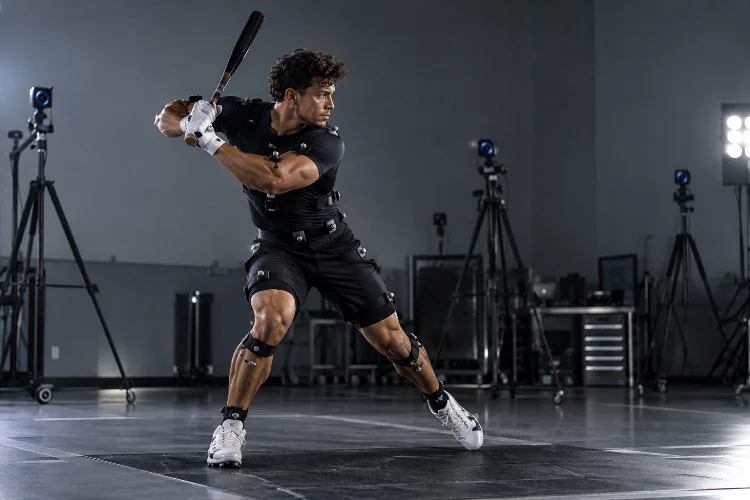
Three-dimensional motion-capture systems can measure pelvic rotation, trunk orientation, joint angles, and movement timing.
Some systems use reflective markers attached to the body, while newer markerless technology estimates movement through camera-based tracking.
These measurments allow coaches and sports scientists to examine how different segments interact throughout the hitting motion.
High-speed video is a more accessible alternative.
Although it can’t provide every measurement available from laboratory equipment, consistent video angles can reveal meaningful differences in balance, stride timing, contact position, and movement coordination.
Force Plates and Wearable Sensors
Force plates measure how much force a hitter applies to the ground and in which directions.
They can help identify differences between the lead and rear legs, as well as changes in loading patterns throughout the swing.
Inertial measurement units, or IMUs, provide another option. These wearable sensors can capture acceleration and rotational movement without requiring a full motion-capture laboratory.
Still, technology has limitations.
Different devices use different definitions, sampling methods, and filtering procedures. Comparing measurements from unrelated systems without understanding their methods can lead to misleading conclusions.
What Coaches Should Actually Track
Rather than collecting every possible data point, start with a few useful indicators.
Monitor bat speed, exit velocity, contact consistency, lead-leg behavior, and the timing of major rotational events.
Then compare the results under similar conditions.
For example, a hitter might complete three sets of ten tee swings while recording bat speed and contact quality.
After several training sessions, repeat the assessment with the same bat, tee position, and effort instructions.
Look for consistent trends rather than celebrating one unusually fast swing.
And remember that a successful swing analysis should connect mechanical changes with actual hitting performance, not just produce attractive charts.
7. Training Strategies to Develop Explosive Rotational Power
Build Strength Before Chasing Maximum Speed
Better hitting mechanics require enough physical capacity to support forceful movement.
Lower-body strength, trunk control, hip mobility, and upper-body coordination all contribute to the process.
Exercises such as squats, split squats, Romanian deadlifts, and lateral lunges can help develop the physical foundation for powerful hitting.
The idea isn’t to turn every baseball player into a competitive powerlifter.
Instead, the goal is to improve strength and stablity while maintaining the mobility and movement quality needed for an effective swing.
Research using baseball’s OpenBiomechanics dataset has identified associations between hitting performance, trail-leg rotation, and lead-knee extension.
That supports paying attention to lower-body movement rather than focusing entirely on the arms.
Train Rotation With Medicine Ball Throws
Medicine ball exercises provide a practical way to develop explosive rotational movement.
One example is the rotational scoop toss.
Stand sideways to a sturdy wall, hold a suitable medicine ball near the rear hip, and rotate explosively to throw the ball toward the wall.
Allow the lower body and trunk to work together instead of simply throwing with the arms.
Another useful variation is the step-behind rotational throw, which introduces controlled forward movement before rotation.
These drills can reinforce coordination and power production, but they shouldn’t be treated as perfect replicas of hitting.
Throwing a medicine ball and swinging a bat involve different loads, movement demands, and timing constraints.
Improve Mobility Without Forcing Rotation
Rotational power also depends on having sufficient movement freedom.
Hip internal and external rotation, thoracic spine mobility, and controlled trunk movement are particularly relevant.
A study examining hip kinematics in elite baseball batters highlighted the different rotational demands placed on the lead and trail hips.
These findings help explain why a single generic stretching routine may not address every player’s limitations.
Useful preparation can include controlled hip rotations, thoracic mobility exercises, and gradual rotational warm-ups.
Avoid forcing end-range spinal twisting, particularly when discomfort is present.
Make Training Specific to Real Hitting
General physical preparation matters, but its benefits must eventually transfer into baseball-specific movement.
Tee work helps players focus on controlled mechanics. Front toss introduces more timing demands, while live pitching tests whether those improvements survive under realistic conditions.
A hitter might display excellent rotational coordination during an isolated drill but revert to inefficient habits when facing high velocity.
That’s why training should gradually progress toward unpredictable pitch locations and speeds.
Short, high-quality swing sessions are often more useful than repeatedly swinging until fatigue compromises technique.
Track performance over several weeks and adjust the workload according to the athlete’s experience and recovery.
Most importantly, don’t chase rotational power at the expense of timing and contact.
The real objective is to develop a hitter who can swing explosively, recognize pitches, adjust quickly, and consistently deliver the barrel where it needs to be.
Understanding the biomechanical analysis of rotational power in baseball hitters changes how we think about hitting performance.
Powerful swings don’t simply come from muscular arms or aggressive hip rotation. They emerge from coordinated ground reaction forces, effective pelvic and trunk movement, proper kinetic sequencing, and precise barrel delivery.
Research shows meaningful relationships between lower-body forces, hip-shoulder coordination, and bat speed, but there’s no universal mechanical formula for every hitter.
The smartest approach combines strength development, mobility, video analysis, and baseball-specific practice with measurable results.
Ready to improve your swing? Start by recording your mechanics, identifying one area that needs improvement, and testing a focused training adjustment.
Better rotational power isn’t about swinging harder at all costs. It’s about making every movement count.